Altcoin
This page lists the latest Altcoin news and market analysis. Browse articles, expert insights, and updates in this category on JrKripto. Stay informed with in-depth coverage of cryptocurrency trends and developments.
News
Altcoin News
Browse all Altcoin related articles and news. The latest news, analysis, and insights on Altcoin.
A new crisis has erupted in crypto startups bearing the Trump family's name. Family-linked World Liberty Financial (WLFI) took action to stop a cryptocurrency wallet using the “Trump” name. Bloomberg reported on June 6 that WLFI sent a cease-and-desist letter to Fight Fight Fight LLC, demanding that they cease and desist the venture.Trump family takes action against unauthorized walletAccording to Bloomberg, WLFI sent a cease-and-desist letter to Fight Fight Fight LLC. The wallet was announced in collaboration with NFT platform Magic Eden, but did not receive any approval from the Trump family or the Trump Organization. Social media accounts promoting the project were quickly deleted, while WLFI's swift response made it clear that the project had no “official” ties.“The Trump Organization has nothing to do with this wallet,” Trump's eldest son Donald Trump Jr. said on social media on June 3, announcing that WLFI would soon introduce its own official wallet project. Eric and Barron Trump have similarly distanced themselves from the project.However, the wallet crisis has not only had legal but also economic repercussions. Following WLFI's cease-and-desist letter, the $TRUMP token, which was launched as a meme coin, lost 11% of its market capitalization to approximately $130 million. The token started trading at $9.61 after the news. However, trading volume increased 129% to more than $713 million.Fight Fight Fight LLC, the company behind the project, is best known for launching the $TRUMP token at the beginning of the year. The company is headed by Bill Zanker, a longtime friend of Trump. Zanker has previously authored Trump-themed NFT collectibles and has been at the forefront of many of Trump's digital asset projects. WLFI's “official” crypto projects include a USD1 stablecoin pegged to the US dollar and special event rewards.How is WLFI doing? As of March, WLFI had raised approximately $550 million through two public token sales. The platform has come under closer scrutiny after launching its USD1 stablecoin in May. An Abu Dhabi-based company announced plans to use the stablecoin to pay for a $2 billion investment in Binance. The Trump family holds a stake in WLFI and indirectly profits from the platform's transaction fees through a company affiliated with the US president.As we previously reported, some Democratic members of the House of Representatives and Senate have accused Trump of using his presidential position to profit financially from crypto ventures.These allegations have the potential to slow or completely halt the progress of digital asset-related bills in Congress. Bills to create a market structure framework for digital assets and regulate payment stablecoins are currently pending in the House and Senate.

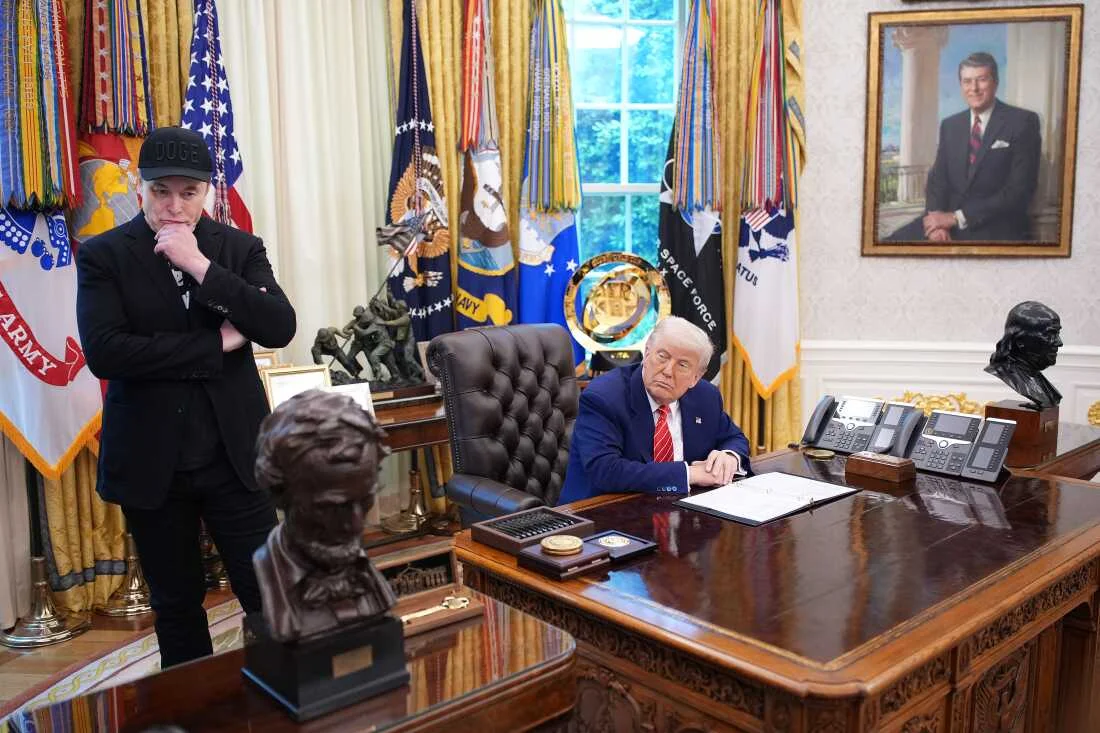
The highly publicized confrontation between US President Donald Trump and Tesla and SpaceX CEO Elon Musk has caused serious volatility not only in Washington but also in the crypto markets. In particular, Musk's outburst against Trump's controversial spending bill, dubbed the “Beautiful Bill”, led to a sharp sell-off in Bitcoin and altcoins. Spot ETF outflows, billion-dollar-plus liquidations and shaken investor confidence left markets with one of the harshest days of June 2025.A wave of selloff in the crypto market: $1 billion in liquidationsMusk-Trump tension has turned the markets upside down. The price of Bitcoin (BTC) fell by over 4% to around $100,000, while leading altcoins such as Ethereum (ETH), Solana (SOL), XRP and Binance Coin (BNB) lost between 4% and 8%. Ethereum, in particular, hit a weekly low of $2,400 after being rejected at $2,700. According to Coinglass data, $260 million worth of long positions were liquidated in ETH futures alone. The total value of cryptocurrencies dropped from $3.4 trillion to $3.3 trillion. Total daily liquidations exceeded $ 1 billion. On the Bitcoin side alone, $341 million worth of positions were closed. Most of these liquidations were due to long positions. Yesterday's $278 million outflow from spot BTC ETFs also shows that institutional investors are reacting to the uncertainty caused by the Musk-Trump conflict. Heavy accusations from Elon Musk against TrumpThe issue that sparked the tension was the giant spending bill in Congress. Elon Musk slammed the bill, arguing that it “disgraced” the US budget. Twitter founder Jack Dorsey supported Musk by suggesting Bitcoin as an alternative in this process. In his response, Trump announced that he would cancel Musk's government contracts. Musk responded to this threat by announcing that SpaceX would retire the Dragon spacecraft.But the tension did not end there. Musk signaled a new scandal by claiming that Trump was named in the Epstein documents and therefore had not released them until now. These statements shook the balance in Washington and weakened Elon Musk's position on the political front. Musk loses $27 billion, Tesla shares plummetElon Musk's harsh outbursts against Trump have shaken both his political allies and his financial power. As it is known, Musk frequently voiced his support for Trump during Trump's presidential campaign. While Tesla shares fell, Musk lost a fortune of 27 billion dollars this week alone, according to Forbes data. He is still the richest person with a fortune of 388 billion dollars.In the House of Representatives, many Republicans openly criticized Musk while supporting Trump. Texas Republican Troy Nehls lashed out at Elon, saying, “He's acting like he's out of his mind.” Florida Representative Aaron Bean, known as a DOGE supporter, described it as “two friends getting into a fight,” but his efforts to defuse the situation were ineffective.Are we entering a new period of uncertainty for the crypto sector?This conflict between Musk and Trump directly affects both the tech world and the crypto markets. In particular, Musk-influenced assets such as Bitcoin and DOGE are now more fragile due to the political winds. On the other hand, although new liquidity inflows to crypto markets are expected if the spending bill is passed, political tensions seem to overshadow investor confidence in the short term.

US law enforcement has dealt a major blow to BidenCash, one of the dark web's best-known illegal marketplaces. According to a statement by the Department of Justice, 145 internet domains linked to BidenCash and approximately $17 million in cryptocurrencies were seized as part of the FBI-led operation.More than 15 million credit card details soldBidenCash, which has been operating since 2022, attracted attention by selling stolen credit card information, personal data and compromised login credentials on the dark web and open internet. The platform offered its users the opportunity to pay anonymously with cryptocurrency, providing both privacy and making it difficult to track. BidenCash, which is thought to have generated at least $17 million in revenue, served approximately 117,000 users.The platform also reportedly released millions of credit card details for free from time to time to expand its illegal operations. According to officials, between October 2022 and February 2023, 3.3 million credit card details were shared for free for promotional purposes. This data included highly sensitive information such as card numbers, expiration dates, CVV codes, first and last names, addresses, e-mail and phone numbers.A major operation was carried out with global cooperationThe operation was not limited to the US. In addition to the FBI, the US Secret Service, the Dutch National Police, and cybersecurity organizations such as the Shadowserver Foundation and Searchlight Cyber were also part of the operation. The 145 domains in question are currently redirected to official US government seizure pages. However, according to Arkham Intelligence data, authorities seized approximately $43,000 in Tether (USDT) assets during the operation. Although BidenCash's infrastructure was largely taken down, cybersecurity experts revealed that some domains linked to the platform are still active. Security researcher Vmprotect, using a tool called Domainhunter.pro, has identified at least seven active domains.New era against crypto-focused crimesThe year 2025 is characterized by law enforcement's tough fight against dark web and crypto-based crimes. In May, Europol detained hundreds of people in 10 different countries as part of “Operation RapTor” against the cryptocurrency-funded fentanyl trade. The BidenCash operation is seen as an extension of this global crackdown.Cryptocurrencies are frequently preferred for illegal activities due to their privacy and ease of cross-border transfer. However, as we have seen in examples like BidenCash, it is impossible to say that these illegal systems are “undetectable”.

US-based cryptocurrency exchange Coinbase has launched two new wrapped tokens, cbXRP and cbDOGE, on its Layer-2 network Base.cbXRP and cbDOGE launch from CoinbaseHolders of XRP and Dogecoin (DOGE) now have access to decentralized finance (DeFi) opportunities on Coinbase's Layer-2 blockchain network Base. This is because Coinbase has launched XRP and DOGE on the Base network. These new assets are fully backed by XRP and Dogecoin (DOGE) and are stored in Coinbase's institutional wallets. With this move, the company aims to offer more cross-chain integration to the DeFi ecosystem on the Base network.According to Coinbase's official statement, users will now be able to transfer DOGE and XRP assets held in their Coinbase accounts to the Base network, where they will be automatically converted into cbDOGE and cbXRP tokens. This conversion takes place at a 1:1 ratio and can be used as ERC-20 compliant assets on the Base network. This means that users will now be able to utilize their coins, such as XRP and DOGE, which have limited use cases on traditional chains, on Ethereum-compatible DeFi protocols.“These new assets expand Coinbase's portfolio of wrapped tokens and facilitate participation in the on-chain economy through Base's open and permissionless nature,” Base's development team said in a statement following the launch.First-day data shows significant interest in the market. According to Coinbase, 2.3 million cbXRP (about $5 million) and 10.4 million cbDOGE (about $1.9 million) entered circulation within 24 hours. On-chain market capitalization of XRP. Source: BaseScan This development is a continuation of Coinbase's wrapped asset strategy launched last year. In September 2024, the company launched cbBTC, a wrapped Bitcoin, which quickly reached a market capitalization of more than $4 billion. cbBTC's success prompted Coinbase to increase its investments in this area.Following cbXRP and cbDOGE, Coinbase is preparing to launch cbLTC and cbADA. These tokens are expected to be integrated into the Base network in the near future.Base is a Layer-2 blockchain network built on Ethereum. It aims to leverage the security and decentralization of Ethereum while reducing transaction fees using Optimism's OP Stack technology.Base network is growingOn the other hand, the Base network has also been showing steady growth recently. The network, which reached a stablecoin transaction volume of $3.6 trillion in the first quarter of 2025, is among the leading Layer-2 platforms in terms of total locked assets (TVL). The number of users increased from 450,000 to 900,000 in just three months.

The U.S. Securities and Exchange Commission (SEC) has officially begun reviewing the spot SUI ETF application submitted by 21Shares. This development is being interpreted as a signal that a lesser-known yet ambitious Layer-1 blockchain like SUI is stepping onto the institutional stage—following in the footsteps of Bitcoin and Ethereum.The acceptance of the application does not mean it has been approved. However, the fact that the SEC has initiated the evaluation process already provides significant visibility for SUI. Previously, only major blockchain projects had a place in institutional investment products, but this move shows that SUI is stepping up to a new league.What Does the SUI ETF Represent?The product submitted by 21Shares is designed to track SUI tokens purchased directly from the spot market. In other words, this is not a futures-based ETF; it is an institutional investment product that provides direct exposure to the price of SUI.This detail is crucial, as the Bitcoin and Ethereum ETFs that were approved also operate as spot products—creating lasting impacts on the prices of those assets. Whether the same will happen for SUI remains to be seen in the coming period.Why Now, and Why SUI?SUI is a Layer-1 blockchain developed by Mysten Labs, known for its high transaction speed, parallel execution capability, and its architecture built using the Move programming language. In recent months, SUI has shown significant growth both in on-chain activity and in Total Value Locked (TVL). However, it is still considered a newcomer on the radar of institutional investors.This is where 21Shares’ move gains strategic significance. Leveraging its experience with Bitcoin and Ethereum products, 21Shares is now aiming to gain early exposure to rising stars like SUI by applying the same institutional framework.The SEC’s decision to review this application can be seen not just as a step forward for 21Shares, but also as a broader indication that "alternative Layer-1s" are beginning to find more space in the world of institutional investing.What Happens if the ETF Is Approved?If the SEC approves this application, it would mark a major milestone not only for SUI but for all alternative Layer-1 projects. In a landscape where only heavyweight assets like Bitcoin and Ethereum have received ETF approval so far, making room for a younger project like SUI would open an entirely new chapter.In that case:Institutional funds could directly invest in SUI,Liquidity in the spot market would increase,Price behavior could shift,On-chain activity on the SUI network could accelerate,Other Layer-1 projects might follow suit and submit similar applications.

AVAX Technical Analysis - Daily ChartAVAX is stuck between horizontal support–resistance levels after exiting the Decelerating trend structure that has been going on for weeks. It is currently trading at $20.87 and is trying to hold on just above the $20.10 support. This region is a threshold where buyers have been active recently. AVAX Current Levels The first line of defense below is $20.10. If this place breaks, there may be a gap up to the $16.76 level. $ 16.76 stands out as a critical threshold due to the fact that it is a long-term support and a previous bottom zone. Persistence below this level can accelerate the decline.In the upward movements, the first resistance is $23.09. Then, the $24.43 and $28.60 levels should be carefully monitored. It seems difficult for AVAX to start a strong trend again, especially unless there are closures above $28.60. This level was the region where the falling trend was broken, but permanence could not be achieved.In general, AVAX is moving horizontally in the short term. As long as it remains above $ 20.10, the possibility of a recovery remains on the table. However, as long as a strong momentum is not captured, upward movements may remain limited in the resistance zones.

EDU Technical Analysis – 4-Hour ChartEDU, after breaking down the rising channel structure, went in search of direction in the short term. The price is currently trading at the levels of $0.1471 and quite close to the resistance of $0.1482. This was a region that used to work as both support and resistance. Therefore, the price movement that will take place here will determine the short-term direction. EDU Support and Resistance Levels In the upward scenario, closures above $0.1482 should be followed. If this level is exceeded, the first resistance will be at $0.1569, followed by the $0.1844 levels. However, as long as it remains below $0.1482, upward attempts may encounter selling pressure. Especially if $0.1569 is not passed, the rises may remain weak.Below, the $0.1400 and $0.1285 levels should be followed as support. If these regions are broken, the level of $ 0.1032, which was previously a strong buying zone, will be raised again. Under this zone, an area opens up to the $0.0931 dip level.As for the overall structure, EDU is currently trying to get out of technical printing. However, a clear fracture has not yet arrived. Although there is a desire to recover after the channel break, the resistance zones are quite strong. The levels of $ 0.1482 and $0.1569 will be decisive for the clear direction.

Cryptocurrency exchange giant Binance made a fast start to June and shared many new features and campaigns across the platform with its users. We have compiled the highlights of Binance's latest announcements, which draw attention with the diversity in investment products and measures to increase platform security.New program to increase altcoin liquidity launchedBinance aims to create a stronger liquidity environment on certain altcoin trading pairs with the Spot Altcoin LiquidityBoost Program, which will be launched on June 9. Through this program, users will be able to achieve tighter spreads, lower price slippage and an overall more efficient trading experience.Users trading as market makers under the program will benefit from two different incentive levels depending on trading volume. On a weekly basis, users whose trading volume reaches 0.5% of the volume of eligible trading pairs on Binance will receive a rebate of 0.005%, while users who reach 1.0% will receive a rebate of 0.01%.The trading pairs within the program are quite diverse. Binance has included the following spot trading pairs in this liquidity support program:INIT/USDT, EOS/USDT, HYPER/USDT, PARTI/USDT, ICP/USDT, KERNEL/USDT, CFX/USDT, W/USDT, KMNO/USDT, IOTX/USDT, ONDO/USDT, TON/USDT, FIL/USDT, WCT/USDT, BABY/USDT, SXT/USDT, SYRUP/USDT and STO/USDT. By trading in these pairs, participants will be evaluated according to their weekly market maker volumes and will be able to access favorable repayment rates. In addition, for accounts that participate in the Spot Liquidity Provider Program with this program, the more advantageous rate will apply to the pairs traded.New assets added to Binance Loans and VIP LoanBinance has added new crypto assets to its flexible rate borrowing product, Binance Loans (Flexible Rate), and VIP Loan platforms targeting high-volume users. Vaulta (A) can now be used as collateral or borrowing asset in both flexible and VIP loan products. In addition, Haedal Protocol (HAEDAL), Huma Finance (HUMA), Sophon (SOPH) and World Liberty Financial USD (USD1) have been activated in VIP Loan only.New earning opportunities in Yield ArenaThere are also innovations on the Binance Earn front. Among the campaigns within the Yield Arena, BABY Simple Earn Locked Products, offering up to 20.9% APY, and the Dual Investment June leadership program, which distributes rewards up to 3,600 USDC, stand out. In addition, flexible interest rates and bonus tiered reward systems are on the agenda for various cryptocurrencies such as ETH, USDT, USDC, FDUSD, BMT and SOPH. Locked products offer fixed-term high interest rates on tokens such as NEAR, SUI, LISTA.Some pairs are being delistedSome trading pairs that are insufficient in terms of liquidity and trading volume are being removed from the platform. As of 06:00 on June 6, 2025, trading pairs ACX/FDUSD, IDEX/FDUSD, ORCA/FDUSD, THETA/FDUSD and XAI/FDUSD will be discontinued. However, the tokens themselves will still be traded on other trading pairs.Strict control of bot usageFinally, Binance has taken a new step against bot use to maintain fairness in the Alpha program. The exchange announced that it has strengthened its risk control systems to identify accounts that use automated tools to earn Alpha Points. Users who take such actions will be banned from the program and additional sanctions may be imposed.

One of the most notable developments of the day in the crypto world was the airdrop of USD1, the stablecoin of the World Liberty Financial (WLFI) project, which is known to be linked to Donald Trump. The project sent 47 USD1 tokens to the wallets of WLFI token holders who participated in the presale phase. The airdrop took place on the Ethereum network.Airdrop distribution from World Liberty FinancialWorld Liberty Fi has sent a bulk airdrop of 47 USD1 to several addresses believed to belong to early WLFI token recipients. World Liberty Financial had previously announced in a community vote that a small-scale airdrop would be conducted to test the USD1 distribution and reward investors who backed the project early on. This proposal was overwhelmingly approved by 99.96%. The vote received final approval on May 15 and the airdrop was quietly launched on June 4. Although the project did not make an official announcement, numerous users confirmed the distribution on social media.According to the cryptocurrency community, the 47 USD1 sent has not only a financial but also a symbolic meaning. The number is thought to have been chosen in reference to the fact that Donald Trump is the 47th President of the United States. USD1 is a stablecoin that was released in March 2025 and is fully backed by US Treasury bills, cash assets and short-term equivalents. USD1, which is held by BitGo, has seen significant momentum following its launch. According to DeFiLlama data, its circulating supply and market capitalization currently stands at $2.18 billion. So much so that in some periods, there were sudden increases of up to 6700 percent in transaction volume.However, the rise of the project has also brought some concerns. According to Dune Analytics data, 84.4 percent of the USD1 supply is held in only two wallets, while 9.5 percent is held in a third wallet. According to some in the community, this suggests that the token is highly centralized. It remains unclear whether these wallets belong to World Liberty Financial, investors or custodians.On the other hand, the Trump family's role in the project has also sparked public debate. The project whitepaper states that Trump and his three sons are ambassadors or supporters of WLFI. Last month, Democratic Senator Richard Blumenthal's claim that the Trump family had made “substantial” financial gains from the project was dismissed as “baseless” by World Liberty lawyers.Application filed for Trump-backed Bitcoin ETFThe airdrop news is just part of the Trump-related crypto developments. As we reported in the morning, it was announced that Trump Media & Technology Group applied for a spot Bitcoin ETF. At the same time, while rumors circulated that a product called “Official Trump Wallet” would be released, the Trump family denied these claims. A wallet thought to belong to the TRUMP meme coin project reportedly moved 4 million tokens to major exchanges.

South Korea elected its new president after historic elections held on June 3rd. Lee Jae-myung, the Democratic Party candidate and opposition leader, was elected president with 49.42% of the votes in the election, the highest turnout in recent years. His conservative rival Kim Moon-soo remained at 41.15%. This result is quite critical for the Bitcoin and altcoin space. Because Lee Jae-myung is known as a pro-cryptocurrency politician.Pro-crypto candidate elected president in South KoreaThe South Korean presidential elections, the results of which were announced in the first hours of the day, were closely followed in the crypto market. Because it was known that Lee Jae-myung, one of the candidates, supported cryptocurrencies. Lee Jae-myung won the presidential elections, which took place with record participation, with 49.42% of the vote. The election carries the hope of a restructuring for the country, as it comes after a chaotic period that resulted in the failed coup attempt and impeachment of the previous leader Yoon Suk-yeol. Lee's campaign offered hope for economic recovery. However, it was also notable for introducing serious reforms on cryptoassets. What is on the new government's agenda?At the center of Lee Jae-myung's election promises is strengthening South Korea's position in the cryptocurrency market. The new president advocates the legalization of spot Bitcoin ETFs on local exchanges. Following the approval of spot ETFs in the US, the introduction of similar products in South Korea had caused excitement among investors. However, until today, the issuance and trading of such ETFs has remained prohibited in the country.Lee also plans to establish a stablecoin market indexed to the Korean won. Speaking at a policy meeting in May, Lee said, “A won-based stablecoin market is essential to prevent national wealth from fleeing abroad.”The new government's agenda also includes the second phase of crypto asset regulations. These regulations, which will focus on the transparency of stablecoins and crypto exchanges, aim to strengthen investor protection. On the other hand, Lee argues that regulations should be minimized in blockchain innovation zones. This will pave the way for tech startups and make South Korea more assertive in global competition.Lee Jae-myung is not the first president elected in South Korea with pro-crypto promises. The ousted former president Yoon also made similar promises, but no serious progress was made in practice. What is different this time is both the change in global markets and the increasing individual investor interest in South Korea. The number of users registered on crypto exchanges in the country has reached 9.7 million. This corresponds to about 20 percent of the population. It remains to be seen to what extent Lee Jae-myung's crypto-friendly policies will be implemented.

SUI Technical Analysis – 4-Hour ChartSUI has been stuck horizontally in the $3.22–$3.32 band for a while. This region works both as a defensive line for buyers and as an area where sellers apply resistance pressure. Currently priced at $ 3.23, SUI is at the decision stage in this band. SUI Supports and Resistors In the upward scenario, it is difficult to talk about a strong acceleration unless the $ 3.3260 level is clearly broken. If this resistance zone is exceeded, the $3.59 and then $4.29 levels become the target, respectively. Especially the closures above $3.60 may create a rally mood again.Below the $3.22 level is critical. In case of a break, the initial support is at $2.9477. This level is also where the previous strong buying zone started. If it hangs down from here, a wide selling area opens up to the December of $ 2.69 – $ 2.61. This region contains both volumetric support and had worked as a strong consolidation region before the previous rise.In summary, SUI is currently stuck in the horizontal and is looking for direction. While closures below $3.22 may accelerate the decline, prices above $3.3260 may bring buyers back into play. For a clear direction, the breaking of one of these two levels should be followed.

Tether, one of the world's largest stablecoin companies, has taken important steps to both expand its influence in Latin America and open a new chapter in gold-backed crypto assets. The company announced an investment in Orionx, a Chile-based cryptocurrency exchange, and also announced the launch of a new gold-backed, cross-chain stablecoin called XAUt0.Access to gold via blockchain with XAUt0An important development on the Tether front was the introduction of a new gold-backed stablecoin called XAUt0. Launched on the USDT0 network, this token uses LayerZero's Omnichain Fungible Token (OFT) standard. This allows users to transfer XAUt0 between multiple blockchains without any “wrapping” process or bridge solution. The initial launch of XAUt0 on The Open Network (TON), powered by Telegram, also attracted attention. The move is a continuation of a collaboration that began when Tether moved USDt to the TON network in April 2024.Tether's current offering, the Ethereum-based XAUt, is the world's largest gold-backed stablecoin with a market capitalization of $832 million. Each XAUt token is backed by one troy ounce of physical gold stored in vaults in Switzerland. With XAUt0, this asset will now be able to move between chains and reach a wider audience of investors.Gold wind moves to cryptoIn 2025, global economic uncertainties and trade wars triggered investors' search for safe havens. The price of an ounce of gold rose as high as $3,304 at the end of May, with many gold ETFs posting gains in excess of 25% since the start of the year. Tether's XAUt0 move aims to offer a powerful digital alternative to traditional gold investments. This stablecoin is poised to attract investors' attention thanks to its ease of cross-chain integration and the fact that it is backed by physical gold.Tether powers Chile's crypto ecosystemTether also announced that it has invested in a Chile-based cryptocurrency platform called Orionx. Orionx, in which Tether has invested, is known as one of the most established crypto asset platforms in Chile. In addition, Orionx, a financial infrastructure company focused on cross-border payments, aligns with Tether's vision to increase financial inclusion in emerging markets. Tether's strategic investment will directly contribute to the growing crypto adoption in Latin America.The company said in a statement that this investment was made to “build strong and resilient digital payment channels”. Especially in regions where access to traditional banking systems is limited, stable assets like USDT play an important role in increasing economic inclusion.

There was an important milestone in the cryptocurrency world. Robinhood, the US-based online investment platform, officially launched its international expansion in the crypto space by acquiring Bitstamp, one of the world's most established cryptocurrency exchanges, for $200 million. This acquisition is considered to be the most concrete step Robinhood has taken in its goal of reaching institutional crypto investors as well as retail investors.Robinhood acquires cryptocurrency exchange BitstampRobinhood Markets has completed the acquisition of Bitstamp, a global cryptocurrency exchange. Bitstamp, which has offices in Luxembourg, the UK, Slovenia, Singapore and the US, was founded in 2011 and this acquisition is expected to significantly accelerate Robinhood Crypto's worldwide expansion. Bitstamp has more than 50 active licenses and registrations worldwide. It will therefore bring customers from the EU, UK, US, and Asia to Robinhood. Bitstamp has a reputation for transparency and reliability, especially among institutional investors. With over 85 crypto assets listed, Bitstamp has long been seen as a safe haven for investors moving from traditional markets to crypto.Vlad Tenev, CEO of Robinhood, said in a statement after the acquisition that by integrating Bitstamp's many years of experience into their platform, “a more secure and integrated crypto trading era” will begin. The all-cash deal marks Robinhood's strong entry into the institutional crypto trading space, which it has so far shied away from.Opening new doors to Europe and AsiaRobinhood's move not only expands its product portfolio, but also accelerates the company's global growth strategy. The fact that Bitstamp already has an established and active user base in the European Union, the United Kingdom and Asian markets will allow Robinhood to quickly enter these regions. Thus, Robinhood aims to grow into a broader ecosystem targeting not only individual investors in the US, but also institutional players in Europe and Asia.Bitstamp's deep liquidity pools, advanced API connections, and infrastructure for high-frequency trading will be integrated into Robinhood's crypto trading systems, enabling it to provide 24/7 uninterrupted service. This means that Robinhood will offer a more comprehensive and competitive platform for both individual and institutional investors.“Bitstamp by Robinhood” era beginsFollowing the completion of the acquisition, Bitstamp will continue to operate under the name “Bitstamp by Robinhood”. While the brand's existing identity will be preserved, the technology infrastructure will be integrated with Robinhood systems to enhance user experience and product diversity. According to industry experts, this acquisition could be a harbinger of other crypto investments Robinhood will make in the future. It remains to be seen how Bitstamp will continue its operations after the Robinhood acquisition and how Robinhood will benefit from it.

The Solana Foundation took a critical step towards expanding its presence in the Middle East by signing a Memorandum of Understanding (MoU) with Dubai's Virtual Assets Regulatory Authority (VARA) on June 3, 2025. The agreement also includes Solana's plans to establish a “Solana Economic Zone” in Dubai and aims to promote blockchain innovation in the region. Here are the details of the deal...New Solana era in DubaiSolana Foundation plans to establish a Solana Economic Zone in the region under a Memorandum of Understanding (MoU) signed with Dubai's Virtual Assets Regulatory Authority (VARA). This collaboration aims to create a closer collaborative environment between developers and regulators in the crypto sector. Planned activities include skills development trainings, workshops, consulting sessions and industry data sharing. The partnership is hardly surprising given Dubai's leadership ambitions in Web3 governance and blockchain innovation. “This partnership allows Solana founders to directly connect to the momentum in the region,” the Solana Foundation said in a post on social media platform X.Corporate interest on the rise: SOL on companies' radarSolana has been attracting the attention of many companies recently. Most recently, Asia-based fertility services provider NewGenIvf Group Limited announced the other day that it will invest $30 million in staking on the Solana network. The company stated that it made this decision by increasing its confidence in crypto assets after its initial investment of $ 1 million in Bitcoin in December 2024. As part of this strategic move, the company plans to establish a special subsidiary that will focus on crypto asset operations.On the other hand, as we reported in the morning, Solana took its place in Classover Holdings' balance sheet. In this context, the company signed an agreement with Solana Growth Ventures LLC for the issuance of convertible bonds up to $ 500 million. According to the agreement, 80 percent of the proceeds will be used directly in the purchase of SOL. Although the company shares increased by 39.85 percent after the announcement, there was a slight decline in post-session transactions.Slight increase in SOL priceThe Solana (SOL) price rose by 4 percent to $ 162 after these developments. However, there has been a decline of 9 percent in the last seven days, 5 percent in the last 14 days and 4.8 percent compared to the same period last year. Solana fell as low as $ 9 after the FTX collapse in 2022. However, it became one of the best performing cryptocurrencies in 2024. SOL, which has recently struggled to exceed certain price levels, is expected to regain momentum as the Bitcoin price recovers and such strategic moves with Dubai are more widely adopted.

RLUSD, Ripple's enterprise-grade stablecoin, has received approval from the Dubai Financial Services Authority (DFSA) and can now be legally used within the Dubai International Financial Center (DIFC). This opens a new chapter for RLUSD in the Middle East market.Ripple RLUSD will be available in DIFCThe DIFC is a special economic zone established in 2004, where more than 7,000 companies operate today. It is known as an attractive hub for financial and technology companies. Ripple became the first blockchain service provider in this area by obtaining a license from the DFSA last October. Now, the direct integration of RLUSD into the DIFC ecosystem means that the stablecoin can be actively used by companies in the region in areas such as corporate finance transactions, cross-border payments and liquidity management. RLUSD was first launched in December 2024 and received approval from the New York Department of Financial Services (NYDFS) ahead of the launch. Developed under the supervision of the NYDFS, considered one of the most stringent regulatory authorities in the US, RLUSD is backed one-to-one with US Treasuries, bank deposits and cash equivalents. RLUSD is issued natively on both the XRP Ledger and Ethereum networks. Ripple also emphasizes that RLUSD's reserve management is transparently audited, offering confidence to investors and regulators.In a statement in December 2024, Ripple CEO Brad Garlinghouse stated that the launch of the stablecoin under the roof of NYDFS was a conscious strategic choice and said, “In this period when the US is moving towards clearer regulations, we anticipate that the adoption of stablecoins with real use cases and years of trust in the industry, such as RLUSD, will accelerate.”Important names on the advisory boardRLUSD's advisory board includes former Reserve Bank of India Governor Raghuram Rajan and former Boston Fed Vice President Kenneth Montgomery. They are leading the project alongside other prominent figures in the financial world, such as former FDIC Chair Sheila Bair and Ripple co-founder Chris Larsen.RLUSD is traded on many exchangesRipple's US dollar-backed stablecoin has already expanded its reach by being listed on various cryptocurrency exchanges since its launch in December 2024. RLUSD was initially traded on platforms such as Uphold, Bitso, MoonPay, Archax and CoinMENA, and has since been added to exchanges such as Bullish, Bitstamp, Mercado Bitcoin, Independent Reserve and Zero Hash. As of 2025, RLUSD is supported on exchanges such as Bitget, Gemini, Kraken, LMAX Digital, B2C2, Keyrock and JST Digital. Other platforms such as Revolut, Banxa, B2C2, Keyrock, Flowdesk also support RLUSD.