Starknet, one of Ethereum's second-layer scaling solutions, is working on a new technology aimed at increasing privacy on the blockchain. Developed by StarkWare and called STRK20, the new framework aims to enable developers to launch stablecoins and other digital assets with privacy features.
The new system aims to make user transactions private by default, while allowing regulatory bodies to access certain data when necessary. Thus, it is planned to strike a balance between blockchain privacy and regulatory compliance.
The era of privacy at the token level
The STRK20 framework developed by StarkWare is expected to be deployed on the Starknet network this year. The system works by integrating the privacy feature directly into token contracts.
Thanks to this approach, transactions, balances, and transfer details can be hidden from publicly available blockchain data. However, this privacy does not eliminate compatibility with DeFi applications. According to StarkWare, STRK20 will also be compatible with ERC-20 assets, the most common token standard on Ethereum. The company stated that the technology will allow Ethereum and ERC-20 based assets to leverage privacy features. This is expected to create new use cases, such as private DeFi transactions.
No additional infrastructure required
According to the developers, the STRK20 system does not require the establishment of additional infrastructure. Since the privacy feature is directly embedded at the token level, applications can continue to run on the existing Starknet ecosystem.
Technical goals are also quite ambitious. StarkWare aims for transactions to be completed in under five seconds and transaction costs to remain below $0.20. This performance level is thought to make privacy features more useful for financial applications.
StarkWare CEO and Zcash co-founder Eli Ben-Sasson stated that this technology could particularly accelerate the adoption of stablecoins by institutional investors. According to Ben-Sasson, this structure can significantly accelerate institutional adoption by increasing privacy in transfers, swaps, staking activities, and other DeFi activities.
Balancing DeFi Privacy with Regulatory Compliance
The STRK20 framework works by integrating privacy into token contracts. This makes data such as the sender address, recipient address, type of token transferred, and amount invisible in public blockchain records.
A key difference is that the system deviates from classic privacy tools. Instead of relying on external tools like crypto mixers, Starknet's solution offers privacy directly at the token level. This aims to prevent problems such as the splitting of assets into different pools or the fragmentation of liquidity.
Ben-Sasson stated that privacy should not be an afterthought in the DeFi ecosystem, and that STRK20 will provide developers with "a ready-made infrastructure that offers privacy at the token level." According to him, this model allows transactions to remain anonymous while preserving the DeFi experience users are accustomed to.
"Viewing Key" System for Regulation
The new framework aims not only to provide privacy but also to meet regulatory requirements. For this purpose, the system includes special access keys called "viewing keys". Thanks to these keys, authorized institutions can access the details of specific transactions in case of a court order or legal requirement. This allows transactions to remain private while enabling regulatory oversight when necessary.
Stablecoin and Institutional Use Cases
The STRK20 framework is thought to create significant opportunities, especially for privacy-focused stablecoin projects. Such stablecoins can protect users against risks such as front-running while remaining auditable.
In addition, institutional payment systems are seen as an important use case. Companies may not want sensitive financial data, such as employee salaries or payment flows, to be publicly visible on the blockchain. STRK20 can help to hide this data.
A similar need exists in institutional DeFi transactions. Large investors or financial institutions may not want their transaction strategies to be publicly available on the blockchain.
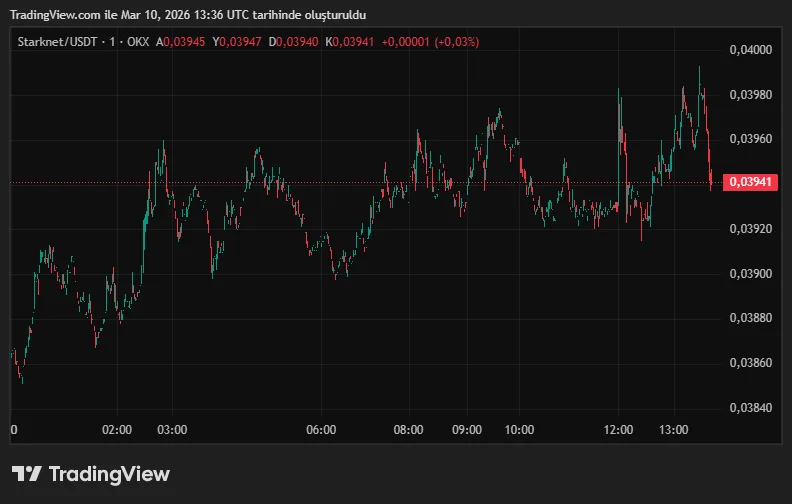
It is stated that the developed privacy technology can also be used for Starknet's recently announced Bitcoin-based asset called strkBTC. This asset aims to allow Bitcoin holders to participate in DeFi applications while keeping balances and transfers private. The Starknet team plans to expand Bitcoin's role in the decentralized finance ecosystem with solutions like these. Privacy features for DeFi users thought that this could make the experience more appealing. Following this development, there was no noticeable change in the price of the StarkNet coin, STRK.